Signal Pilot Suite - Complete Indicator Collection
Welcome to the Signal Pilot Suite - 7 production-ready, non-repainting indicators designed for serious traders. Each indicator is built on the SP Protocol: zero repaint, complete transparency, and professional-grade analysis.
📊 Quick Comparison - Choose Your Indicators Beginner Friendly
⭐ Start Here - Find Your Perfect Match
Not sure which indicator to start with? This table shows how all 7 indicators compare:
| Indicator | Type | Complexity | Best For | Key Signals | Reading Time |
|---|---|---|---|---|---|
| Pentarch v1.0 | Overlay | ⭐ Easy | Swing traders, potential reversals | 5 events (TD/IGN/WRN/CAP/BDN) | 20-30 min |
| Janus Atlas v1.0 | Overlay | ⭐⭐ Medium | All styles, key levels | 60+ level types (HTF/Session/VWAP/Structure) | 60-70 min |
| OmniDeck v1.0 | Overlay | ⭐⭐⭐ Advanced | All-in-one users | 10 systems combined (EC/Squeeze/EMAs/etc.) | 30-40 min |
| Augury Grid v1.0 | Table | ⭐⭐ Medium | Multi-asset scanners | 7-symbol × 3 TF screener with quality scores | 35-45 min |
| Volume Oracle v1.0 | Separate Pane | ⭐⭐ Medium | Volume-focused users, scalpers | Regime detection + signal quality (⭐⭐⭐) | 20-25 min |
| Harmonic Oscillator v1.0 | Oscillator | ⭐⭐ Medium | Momentum users | 7-component voting system for momentum consensus | 30-35 min |
| Plutus Flow v1.0 | Oscillator | ⭐⭐ Medium | Volume analysts | Advanced OBV + divergence detection | 35-40 min |
🎯 Selection Guide
New to the suite? → Pentarch (the simplest single indicator) or Janus Atlas (high analytical impact)
Comprehensive analysis desired? → OmniDeck (10 systems integrated)
Multi-symbol analysis needed? → Augury Grid (7-symbol × 3 TF screener)
Volume analysis focus? → Volume Oracle + Plutus Flow (complete volume analysis framework)
Oscillator preference? → Harmonic Oscillator (7 components voting, 3 of them forming the line)
🎯 The Complete Suite
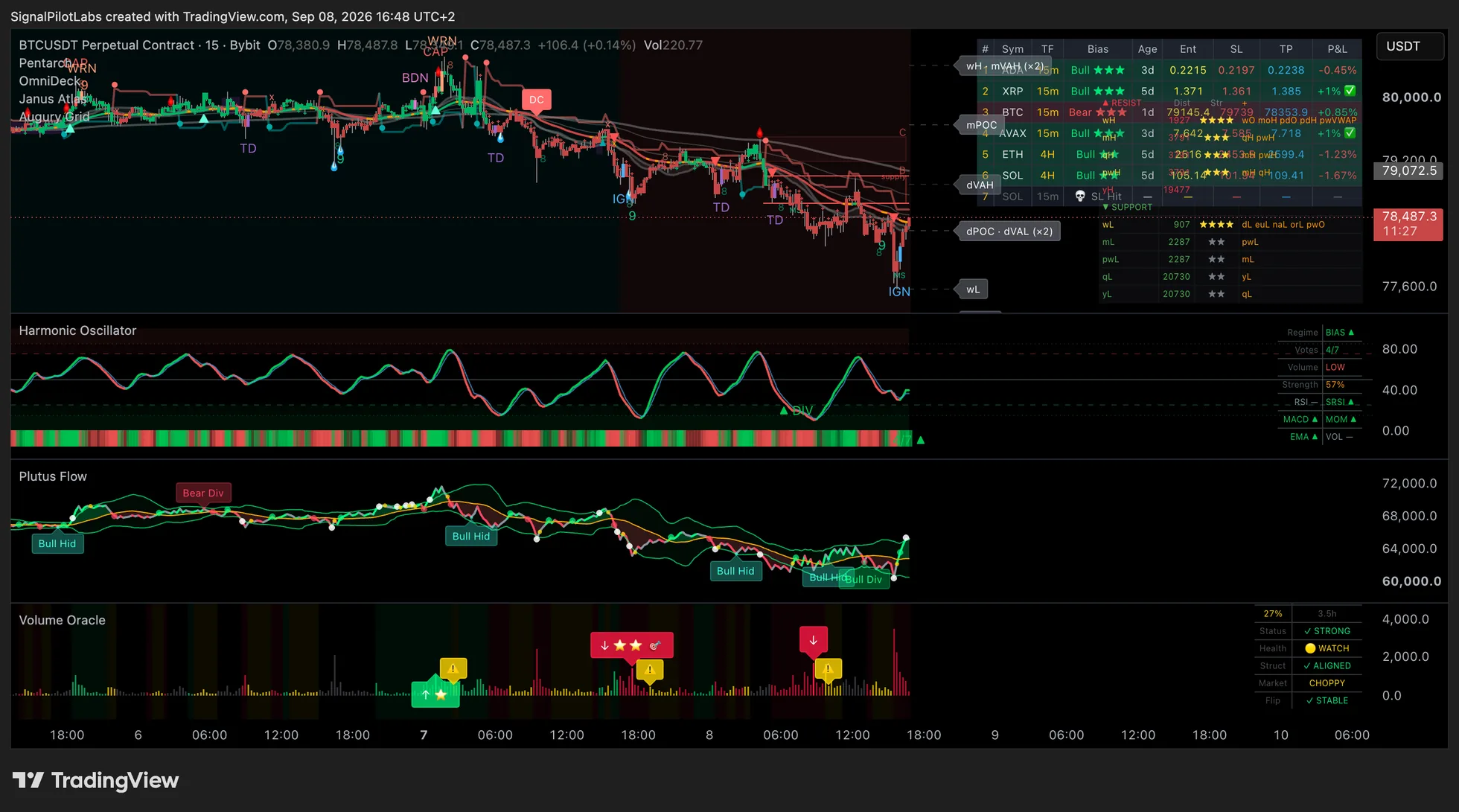
1. Pentarch v1.0 - Potential Reversal Event Detection
Type: Overlay | Complexity: ⭐ Easy
Potential reversal detector with 5 distinct event types: - TD (Touchdown) - Early warning signal - IGN (Ignition) - Potential bullish signal - WRN (Warning) - Late-cycle warning - CAP (Climax) - Exhaustion signal - BDN (Breakdown) - Potential bearish signal
Best for: Swing traders, potential reversal identification, multi-timeframe analysis Key Features: Market regime awareness, event detection, adaptive analysis
2. Janus Atlas v1.0 - Comprehensive Levels System
Type: Overlay | Complexity: ⭐⭐ Medium
Comprehensive market infrastructure overlay with multiple level types: - Higher timeframe levels - Session-based levels - Volume-weighted levels - Volume profile zones - Market structure tracking
Best for: All trading styles - scalping to position trading Key Features: Clean visual display, organized level management, adaptive features
3. OmniDeck v1.0 - The Everything Indicator
Type: Overlay (Multi-System) | Complexity: ⭐⭐⭐ Advanced
Multiple professional indicators integrated into one system:
- Sequential exhaustion detection
- Volatility compression detector
- Liquidity sweep identification
- Moving average analysis
- Multi-timeframe trend detection
- Support band tracking
- Market regime identification
- Supply/demand zone mapping
- Candlestick pattern recognition
- Additional confluence tools
Best for: Traders wanting comprehensive analysis without clutter Key Features: Individual system toggles, clean visual display, integrated features
4. Augury Grid v1.0 - Multi-Symbol Screener
Type: Table-Based Screener | Complexity: ⭐⭐ Medium
On-chart 7-symbol × 3 TF screener with intelligent quality scoring: - Momentum shift detection - Multi-factor quality scoring - Quality tier classification - Target calculation and P&L tracking - Signal freshness monitoring
Best for: Multi-asset traders, swing traders, watchlist management Key Features: Efficient data handling, table-only display, zero repaint
5. Volume Oracle v1.0 - Regime Detection & Signal System
Type: Separate Pane | Complexity: ⭐⭐ Medium
Complete volume-based trading system with 5 integrated systems: - Regime Detection (Accumulation/Distribution/Neutral/Weakening) - Signal Generation (BULL/BEAR with ⭐⭐⭐ quality ratings) - Computed levels (entry, stop and two targets, all derived from ATR) - HTF Confirmation (higher timeframe alignment check) - Strategy Modes (Trend Following/Mean Reversion/Hybrid)
Best for: Volume-focused users, systematic traders, position management Key Features: Quality scoring with visual indicators, multiple alert types, adaptive analysis
6. Harmonic Oscillator v1.0 - Composite Momentum System
Type: Separate Pane | Complexity: ⭐⭐ Medium
Composite momentum system combining multiple oscillators: - Multi-component voting consensus - Normalized scoring scale - Anti-whipsaw protection - Divergence detection (multiple types) - Higher timeframe filtering - Timeframe adaptation modes - Component status display
Best for: Momentum users, divergence traders, multi-indicator users Key Features: Multiple sensitivity modes, quality indicators, multiple alert types
7. Plutus Flow v1.0 - Advanced OBV Analysis
Type: Separate Pane | Complexity: ⭐⭐ Medium
Advanced volume flow analysis with divergence detection: - Enhanced on-balance volume calculation - Dynamic volatility bands - Extreme condition detection - Cross signals with anti-whipsaw protection - Threshold breach identification - Pivot-based divergence analysis - Higher timeframe filtering - Sequential condition requirements
Best for: Volume analysts, divergence traders, flow confirmation Key Features: Clean signal hierarchy, divergence visualization, multiple alert types
Ready to Get Started?
For complete, ready-to-use configurations tailored to different trading styles, see the Configuration Recipes page. It includes 8 detailed setup templates:
- Scalper Setup (5m-15m timeframes)
- Day Trader Setup (15m-1H timeframes)
- Swing Trader Setup (4H-Daily timeframes)
- Position Trader Setup (Daily-Weekly timeframes)
- Conservative, Aggressive, and Combination strategies
- Backtest & Optimization template
🎯 Quick Selector: Analytical Function Mapping
For Trend Identification
- OmniDeck (Regime Box + SuperTrend components)
- Volume Oracle (regime state machine, five detection engines)
- Pentarch (Regime detection + Pilot Line)
For Entry Timing
- Pentarch (IGN/TD event signals)
- OmniDeck (Exhaustion Counter, Squeeze break signals)
- Harmonic Oscillator (Composite consensus signals)
For Potential Reversal Detection
- Pentarch (CAP/WRN/BDN event indicators - potential reversals)
- OmniDeck (Count 9, Liquidity sweep patterns)
- Harmonic Oscillator (Divergence patterns)
- Plutus Flow (OBV divergence patterns)
For Key Level Analysis
- Janus Atlas (Comprehensive levels: HTF, session, VWAP, volume profile, structure)
- OmniDeck (SD Zone mapping)
For Volume Confirmation
- Volume Oracle (Regime detection + signal quality ratings)
- Plutus Flow (OBV analysis + divergence detection)
For Multi-Symbol Screening
- Augury Grid (7-symbol × 3 TF table-based screener)
For Comprehensive Analysis
- OmniDeck (10 integrated systems)
- Janus Atlas + Pentarch + Volume Oracle (The Trinity combination)
🏆 Recommended Combinations Intermediate
💡 Proven Setups - What Works Together
The Minimalist Setup (2 indicators)
OmniDeck + Janus Atlas - OmniDeck: Signals, regime, patterns, zones - Janus Atlas: Levels for entry/exit precision - Result: Complete coverage, minimal clutter
The Pro Setup (3 indicators)
Pentarch + Janus Atlas + Volume Oracle - Pentarch: Potential reversal events and regime - Janus Atlas: Key levels and structure - Volume Oracle: Regime confirmation and risk management - Result: The "Trinity" - event + level + volume confluence
The Master Setup (4 indicators)
Pentarch + Janus Atlas + Harmonic Oscillator + Plutus Flow - Pentarch: Potential price reversal events - Janus Atlas: Structural levels - Harmonic: Momentum consensus - Plutus: Volume flow divergences - Result: Four-pillar confirmation system
The Scalper Setup
OmniDeck (Squeeze + ST + Regime) + Janus Atlas (Session Levels + VWAP) + Volume Oracle (Regime + Signals) - Fast signals, tight levels, regime confirmation - Timeframe: 5m-15m
The Swing Trader Setup
Pentarch (Daily) + Janus Atlas (Weekly/Monthly levels) + Augury Grid (scan multiple symbols) - Potential reversals, major levels and multi-asset screening in one read - Timeframe: Daily/4H
The Position Trader Setup
Pentarch (Weekly) + Janus Atlas (Monthly/Quarterly) + Harmonic Oscillator (Conservative mode) - Major potential trend changes only, key levels, ultra-filtered momentum - Timeframe: Weekly/Monthly
✅ Knowledge Check
Question: Which three indicators make up "The Trinity" combination?
📊 SP Protocol Compliance
All 7 indicators are SP Protocol compliant:
✅ Zero Repaint
- All signals gated by
barstate.isconfirmed - All HTF calls use
lookahead=barmerge.lookahead_off - All pivots/labels use confirmed bar anchoring
✅ Complete Transparency
- Repaint audit included in each guide (line numbers)
- Behavioral contract (unconfirmed vs confirmed behavior)
- Known limitations documented
- Reproducibility tests provided
✅ Professional Quality
- Optimized performance (label budgets, zoom-aware rendering)
- Timeframe adaptation where appropriate
- Alert conditions (all confirmed-only)
- Version history tracking
🎓 Learning Path
📚 Beginner Roadmap - Progressive Structure
Week 1: Foundation
- Janus Atlas introduction (key level concepts)
- Pentarch addition (potential reversal event patterns)
- Practice focus: Pentarch event identification AT Janus levels
Week 2: Volume Confirmation
- Volume Oracle addition (volume analysis framework)
- Practice focus: Pentarch signals WITH Volume Oracle confirmation
Week 3: Momentum Filtering
- Harmonic Oscillator addition (momentum voting system)
- Practice focus: Pentarch signal filtering by Harmonic extremes
Week 4: Advanced Techniques
- Plutus Flow addition (OBV divergence patterns)
- Practice focus: Divergence pattern recognition at key levels
Week 5: Multi-Asset Scanning
- Augury Grid addition (watchlist screening)
- Practice focus: Optimal setup identification across 7 symbols × 3 TFs
Week 6: Complete Integration
- OmniDeck addition (the ten systems, on top of what you already read)
- Practice focus: Multi-indicator confluence pattern analysis
💡 Professional Guidelines
Progressive Implementation
- Simultaneous loading of all 7 indicators is not recommended
- 1-2 indicator mastery before progressive addition
- Complexity does not equal superior results
Confluence Analysis
- Single signal = Observation point
- Two signals = Increased attention warranted
- Three or more = the strongest agreement the suite can show you, which is still agreement and not a forecast
- Example: Pentarch IGN + Janus Weekly Low + Volume Oracle Accumulation regime = all three agreeing
Regime Adherence
- All indicators incorporate regime/trend components
- Green regime = Long bias contexts
- Red regime = Short bias contexts
- Trading with the regime rather than against it is associated with improved signal quality
Quality-Based Filtering
- Most indicators feature quality scoring/tier systems
- Potential Elite/Premium signals = Typically prioritized
- Standard/Weak = Often filtered unless exceptional confluence present
- Quality prioritization over quantity is fundamental
Performance Tracking
- After twenty readings, compare them along these lines:
- Which indicators were involved, and whether they agreed
- Quality tier the signal carried (Elite against Standard)
- Market regime at the time (bull, bear or neutral)
- Whether the well supported readings looked different afterwards from the thin ones
Style-Specific Customization
- Scalper: Tighter settings, lower timeframes
- Swing trader: stricter thresholds, higher timeframes
- Position trader: Conservative modes, Weekly/Monthly timeframes
- Universal setup does not exist - customization required
📚 Documentation Structure
Each indicator guide includes:
- Overview - What it does, who it's for
- Core Concepts - The underlying logic
- Signal Details - How to interpret each signal
- Quick Start - Beginner setup
- Strategy Examples - Proven playbooks
- Parameters Reference - All settings explained
- Technical Specifications - Performance stats
- SP Protocol Compliance - Repaint audit, limitations, testing
- FAQ - Common questions
- Best Practices - Pro tips
- Integration - How to combine with other indicators
📋 Example Analysis Workflow (Pentarch + Janus + Volume)
Many traders use the indicators together in this sequence:
- Market scanning : Augury Grid can be used to monitor multiple symbols (optional)
- Pattern identification : Watching for Pentarch patterns (IGN or CAP commonly monitored)
- Level confluence : Evaluating if pattern occurs near key Janus Atlas support/resistance
- Volume confirmation : Checking if Volume Oracle shows spike confirming the move
- Setup evaluation : when all 3 agree, three instruments are describing one condition
- Risk management : Traders often place stops below/above recent swing points or key levels
- Target identification : Next major Janus Atlas level is commonly used
An illustration, with made-up numbers:
- Pentarch IGN bullish pattern appeared at $50,000
- Janus Atlas showed Daily Low at $49,950 (50 points away = level confluence)
- Volume Oracle showed Accumulation regime (confirmation)
- Result: three separate readings pointing the same way, which is the shape the workflow is looking for
(Educational example. Past patterns do not guarantee future results. Not financial advice.)
🆘 Support & Resources
- Main Docs: docs.signalpilot.io
- Discord Community: Signal Pilot Discord
- Video Guides: YouTube Channel
- GitHub: Signalpilot/signalpilot-docs
🎯 Implementation Pathways
Available starting points based on experience and focus:
- New to technical analysis? Janus Atlas (levels) + Pentarch (signals) combination recommended
- Experienced with indicator analysis? OmniDeck (all-in-one) provides comprehensive integration
- Volume-focused analysis? Volume Oracle offers volume-centric framework
- Divergence analysis preference? Plutus Flow or Harmonic Oscillator provide divergence detection
- Multi-asset screening required? Augury Grid enables cross-symbol analysis
Signal Pilot Suite: Professional market analysis tools designed for systematic decision-making frameworks.
Last Updated: September 2026 | Signal Pilot Suite Complete
Become a Signal Pilot Affiliate
Earn 15–30% recurring commissions promoting Signal Pilot to your audience. Perfect for trading educators, YouTubers, Discord community leaders, and finance bloggers.
| Tier | Referrals | Commission |
|---|---|---|
| Starter | 0–9 | 15% |
| Growth | 10–24 | 20% |
| Pro | 25–49 | 25% |
| Elite | 50+ | 30% |
30-day cookies | Monthly payouts via Gumroad | No tier demotion | Growth+ gets free indicator access