Published as a TradingView Idea on BTCUSDT. View the chart on TradingView
The first week of November carries both US jobs reports, two ISM surveys and a midterm election. On 28 September we measured the jobs reports and made two claims. Here is how they held up, and the week ahead.
How we measure it
For each release, take the hour it lands in and measure that hour’s move, open to close, as an absolute percentage. Divide by the coin’s median hourly move over the same window. 1.00 means the release hour looked like any other hour. BTC, ETH and SOL, 12 August 2025 to 14 October 2026, every US release TradingView flags high, each hour counted once.
It’s the yardstick of our ranking of the US releases that move crypto and of our September jobs week post, which made the two claims graded here.
What we said, and what happened since
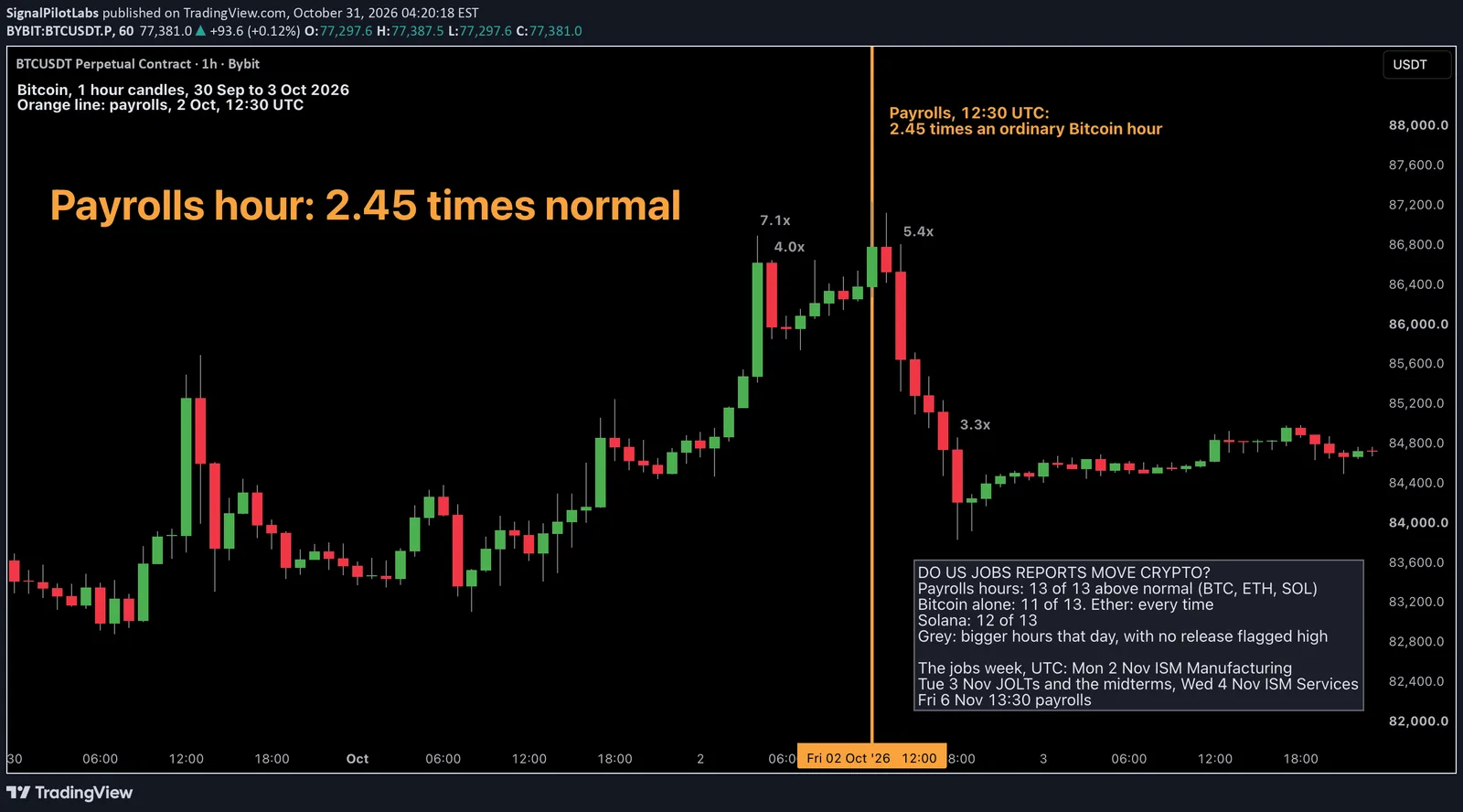
Payrolls: we said it had never had a quiet hour, 12 of 12 above an ordinary hour. It printed again on 2 October and moved 1.84 times. Now 13 of 13. Median 2.45 times.
JOLTs: we said it is big when it moves, and about a third of the time it doesn’t, 4 of 12 quiet. Its 29 September hour moved 2.29 times. Now 4 of 13 quiet, median 3.54 times, still the highest on the US calendar.
The week, in UTC
US clocks change on 1 November, so releases set in US time print an hour later in UTC than in October. The times below are TradingView’s calendar.
| Release | When (UTC) | Median hour (times an ordinary hour) | Quiet hours |
|---|---|---|---|
| ISM Manufacturing | Mon 2 Nov, 15:00 | 2.44 | 4 of 14 |
| Midterm elections | Tue 3 Nov | not measured | the last ones were in 2022 |
| JOLTs | Tue 3 Nov, 15:00 | 3.54 | 4 of 13 |
| ISM Services | Wed 4 Nov, 15:00 | 2.14 | 4 of 14 |
| Payrolls and the unemployment rate | Fri 6 Nov, 13:30 | 2.45 | 0 of 13 |
| Michigan sentiment | Fri 6 Nov, 15:00 | 2.85 | 4 of 15 |
A quiet hour is one that moved less than an ordinary hour, BTC, ETH and SOL together.
Coin by coin
The 13 of 13 is the three coins together, hour by hour. Ether alone moved more than normal on all 13 payrolls hours, Solana on 12, Bitcoin on 11: it was quiet on 9 January (0.86 times) and 5 June (0.07 times).
The chart
The latest payrolls hour, 2 October, Bitcoin, 1 hour. It moved 2.45 times an ordinary Bitcoin hour. Four hours that day moved more, with nothing flagged high on the US calendar: 04:00 UTC at 7.1 times, 14:00 at 5.4, 05:00 at 4.0 and 18:00 at 3.3. Payrolls moves every time. It isn’t always the biggest hour of its day.
What this does not tell you
Which way. It measures how much the hour moved, not direction, and it doesn’t tell you to buy or sell. Thirteen hours is a small sample, about thirty releases are compared, and it’s in sample. The election isn’t in it at all.
What it’s good for is knowing what you’re holding into. In the first week of November, that’s a lot of hours that have moved before.
Observations, not recommendations.
We’re Signal Pilot Labs. We build the Elite Seven, seven indicators for TradingView, and we post what we measure, including the parts that didn’t work.
See what we build at signalpilot.io.
Published as a TradingView Idea on BTCUSDT. View the chart on TradingView
Past measurement described after the fact. Nothing here is a recommendation or an indication of future results.