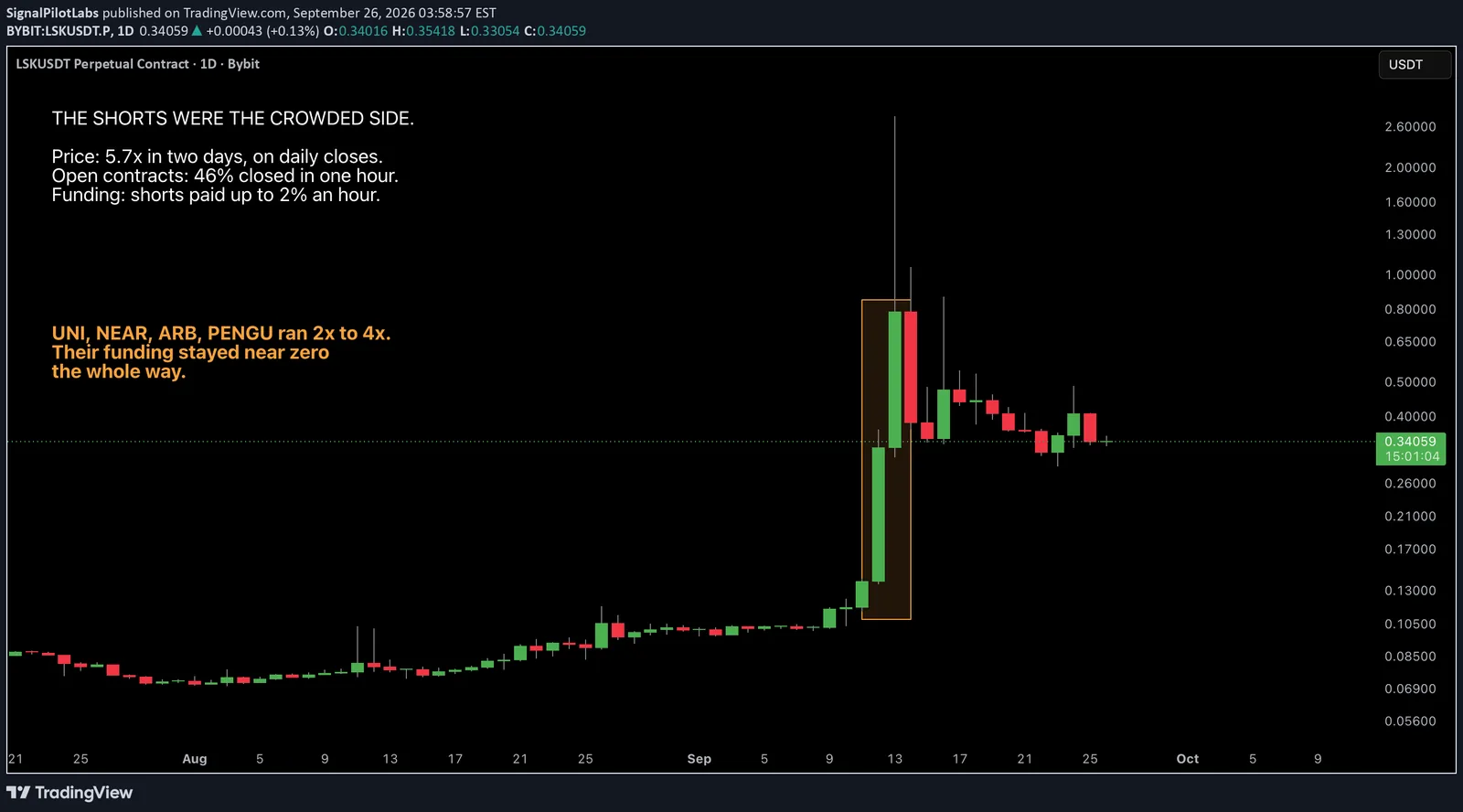
Published as a TradingView Idea on LSKUSDT. View the chart on TradingView
UNI, NEAR, ARB and PENGU all ran hard this summer. UNI roughly quadrupled from its July low, NEAR and ARB more than tripled from their August lows, and PENGU doubled.
On all four, funding stayed inside a narrow band the whole way: between minus 0.03 and plus 0.01 percent per eight hours. Nobody on either side paid much to hold their position.
| Coin | Run | Funding per 8 hours | Summed over the run |
|---|---|---|---|
| UNI | 4.04x | -0.02% to +0.01% | +1.12% |
| NEAR | 3.13x | -0.02% to +0.01% | +0.85% |
| ARB | 3.54x | -0.02% to +0.01% | +0.53% |
| PENGU | 1.98x | -0.03% to +0.01% | +0.92% |
| LSK | 5.7x in two days | as low as -16% | -73.43% |
That last row is the article. Everything below is how LSK got there and how you would have seen it coming without any indicator at all.
The build
Between 1 August and 9 September LSK ground up about 62 percent. Slow, unremarkable, the kind of drift nobody writes about.
Then on 12 September the close went from 0.138 to 0.328, and open contracts went from 13.5 million coins at the start of the day to 51.6 million by the end of it. Nearly four times as many contracts open as there had been that morning.
From 04:00 UTC that day, every funding settlement was negative, down to minus 0.72 percent per four hours.
Negative funding means the perpetual is trading below the spot price, because more traders are pressing to be short than long, and so the shorts pay the longs to keep their position open. Put the three together. Price rising. Contracts piling up. The shorts paying for the privilege of staying in. The crowd was leaning short into a rally.
The hour
At 03:00 UTC on 13 September LSK opened the hour at 0.78, traded as high as 2.78, and closed the hour at 1.13.
In that same hour, open contracts fell from 45.1 million coins to 24.5 million. Nearly half of every contract open on the exchange closed inside sixty minutes.
It closed the day at 0.789, which is 5.7 times its close two days earlier.
That is what a short squeeze looks like from the outside: a crowded short, a price that runs against it, and contracts closing far faster than they were opened. You do not need to know who was liquidated. You can see it in the count.
What happened after it
The squeeze did not end the payments.
Funding hit minus 2 percent, which is the lowest Bybit allows on this contract. From that point Bybit began settling LSK funding every hour instead of every four.
On 14 September it printed minus 2 percent seven hours in a row, from 08:00 to 14:00 UTC, while price fell from 0.97 to 0.56. Those seven hours alone come to minus 14 percent. Add the rest of that day’s hourly settlements and it comes to minus 26 percent, in one day, paid by the short side.
From 1 August to the 23 September close, LSK’s funding rates add up to minus 73 percent. On the four calm coins, over their whole runs, they add up to between plus 0.5 and plus 1.1 percent.
The two numbers, and where to find them
Open interest, counted in coins rather than dollars. In dollars it rises whenever price rises, even if not one new position was opened, so a dollar chart of open interest during a rally tells you mostly about the rally. In coins it only moves when contracts are actually opened or closed.
Funding, and specifically its sign. Positive means longs are paying shorts. Negative means shorts are paying longs. Near zero means neither side is crowded enough to pay for the privilege.
Both are published free on the exchange’s own contract page. Neither needs an indicator, a subscription or a backtest.
Two traps we nearly fell into
We did not get this right first time, and both mistakes are easy to make.
The funding clock. A funding rate is quoted per settlement, and the settlement interval is not a constant. It can change in the middle of a move, which is exactly what LSK did: four hours until 13 September, every hour after it. Minus 2 percent an hour is minus 16 percent per eight hours, not minus 4. Our first draft read the hourly prints as though they were still four-hourly and understated LSK by a factor of four. Put every rate on the same clock before comparing two coins, or you are comparing a rate to a rate that means something different.
The open interest stamp. On Bybit a daily open interest reading is the snapshot taken at 00:00 UTC, which is the start of that day and not the end of it, while a daily candle closes at the end. Pair them carelessly and your contracts are a day out from your price. Our first draft did that too: it began counting contracts at the start of 11 September while describing a price move that runs from the 11th’s close to the 13th’s, which made the rise in contracts look like 7.1x. Aligned by the hour, the day contracts actually near-quadrupled is 12 September, at 3.8x. Line them up by the hour.
What this does not tell you
Five coins on one exchange is a contrast, not a rule. Nothing here says every crowded side gets squeezed, or that calm funding means a run is safe, or which way any of these five goes next.
It is also not a claim that the funding caused the move. The order of events is visible and the direction of payment is visible; the causation is not.
And the squeeze was not the end of the story. On 23 September LSK closed at 0.3552: less than half its peak close, and still about five times its early August price.
Every figure here is public Bybit market data, read on 24 September and frozen at the 23 September close. None of it comes from our indicators.
Observations, not recommendations.
Published as a TradingView Idea on LSKUSDT. View the chart on TradingView
Past measurement described after the fact. Nothing here is a recommendation or an indication of future results.