Published as a TradingView Idea on BTC1!. View the chart on TradingView
“CME gaps always fill” is one of crypto’s most repeated lines. CME’s Bitcoin futures used to close for the weekend while Bitcoin kept trading, so Monday often opened away from Friday’s close: a gap. We counted every one, and found out why there are no new ones.
What we measured
CME’s Bitcoin futures, the front month on TradingView, daily sessions from December 2017 to May 2026. A gap is the Sunday evening open against Friday’s close. We left out the weekend after each month’s last Friday, when the contract rolls and the jump is just the next contract’s price: 89 weekends. A gap filled when a later session reached Friday’s close again, counting from the gap session itself.
What we found
Of 324 weekends, 56% opened 1% or more away from Friday’s close, and 32% opened 2% or more away. The typical gap was 1.2%, up a little more often than down. 55.5% of the gaps filled in the very first session, 80.8% within five sessions, about a week, and 95.6% by October 2026.
| Gaps | Count | Filled the same session (%) | Within 5 sessions (%) | Within 20 sessions (%) | By Oct 2026 (%) | Never |
|---|---|---|---|---|---|---|
| Every gap | 317 | 55.5 | 80.8 | 88.0 | 95.6 | 14 |
| 1% or more | 181 | 39.2 | 71.8 | 83.4 | 94.5 | 10 |
| 2% or more | 105 | 34.3 | 64.8 | 80.0 | 97.1 | 3 |
Bigger gaps took longer, though most got there: of the gaps of 2% or more, 34.3% filled the same day, 64.8% within a week and 97.1% in the end. The biggest, +12.5% on 20 May 2019, took 131 sessions. Both halves of the record agree: 79.5% filled within a week in 2018 to 2021, 81.9% in 2022 to 2026.
The 14 that never filled
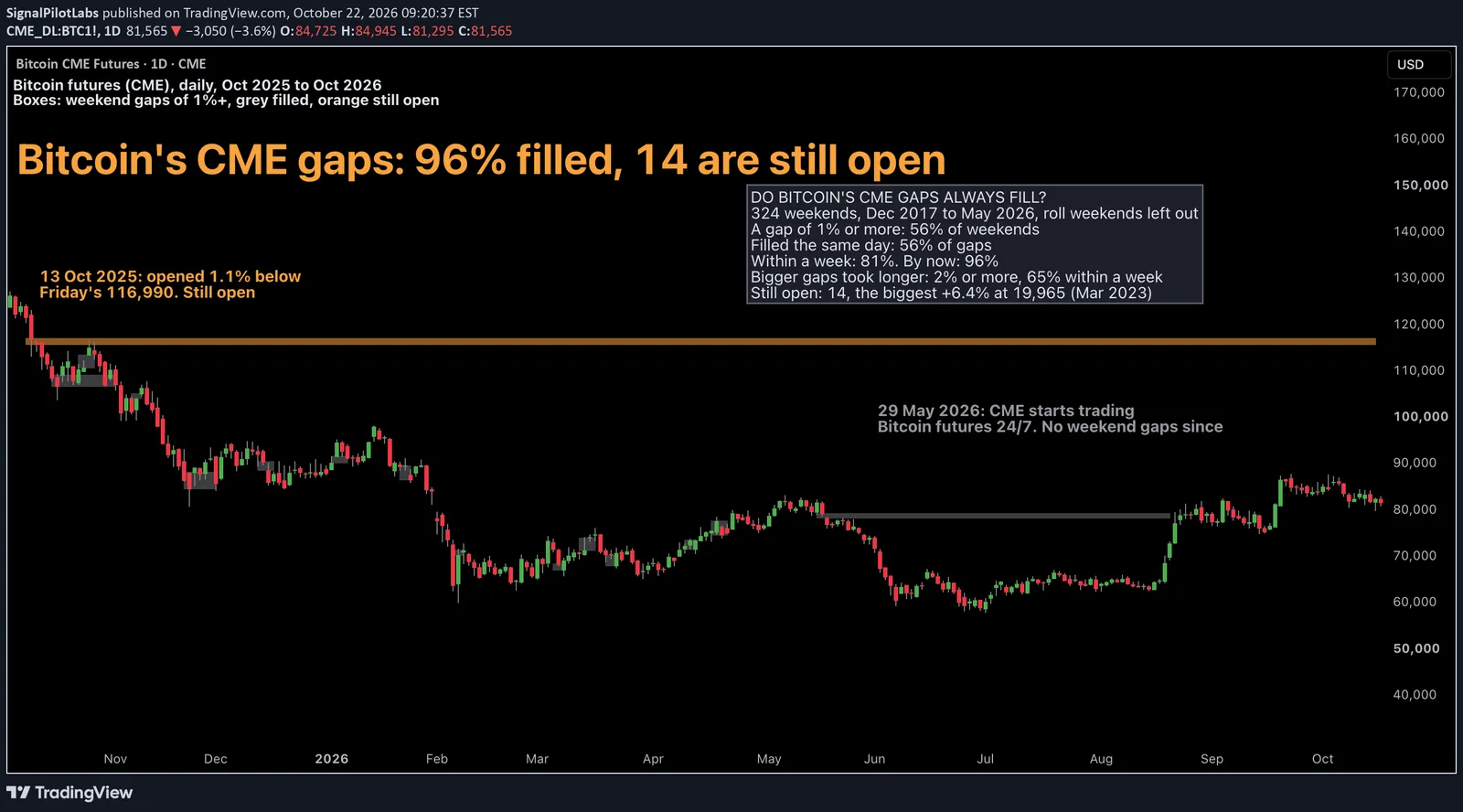
12 of them were gaps up that sit below today’s price, at old levels Bitcoin never went back to. The biggest is +6.44% at 19,965, from 13 March 2023. 2 were gaps down that sit above it: 116,990, from 13 October 2025, and 95,665, from 19 January 2026.
| The Monday | Friday close | Gap (%) |
|---|---|---|
| 2018-12-17 | 3,145 | +1.11 |
| 2019-02-18 | 3,565 | +0.98 |
| 2020-07-27 | 9,615 | +3.22 |
| 2020-10-05 | 10,550 | +1.42 |
| 2020-10-12 | 11,110 | +2.25 |
| 2020-10-19 | 11,360 | +1.28 |
| 2023-01-09 | 16,895 | +0.50 |
| 2023-03-13 | 19,965 | +6.44 |
| 2023-10-16 | 26,840 | +1.62 |
| 2023-10-23 | 29,685 | +0.59 |
| 2024-02-12 | 47,770 | +1.44 |
| 2024-09-09 | 53,695 | +1.62 |
| 2025-10-13 | 116,990 | -1.06 |
| 2026-01-19 | 95,665 | -0.34 |
No new gaps since 29 May 2026
On 29 May 2026 CME started trading its crypto futures around the clock, 24/7. The weekend close is gone, and with it the weekend gap. The old open ones stay where they are.
On the chart
CME Bitcoin futures, daily, October 2025 to October 2026. Each box is a weekend gap of 1% or more, from Friday’s close to the Sunday open, running to the day it filled: grey for filled, orange for the one still open, 13 October 2025.
How to check a gap yourself
- Note the futures’ Friday close and the open of the next session.
- Skip the weekend after the contract’s expiry: that jump is the next contract’s price.
- Count the sessions until the price trades back to Friday’s close.
What this does not tell you
When an open gap fills, or whether it will. A level that filled 96% of the time in the past is a habit of the market, not a rule, and with 24/7 trading there are no new ones to test it on. Past data.
Observations, not recommendations.
We’re Signal Pilot Labs. We build the Elite Seven, seven indicators for TradingView, and we post what we measure, including the parts that didn’t work.
See what we build at signalpilot.io.
Published as a TradingView Idea on BTC1!. View the chart on TradingView
Past measurement described after the fact. Nothing here is a recommendation or an indication of future results.