Published as a TradingView Idea on GBPUSD. View the chart on TradingView
Which hour of the day does your forex pair move most? We measured the three biggest, EUR/USD, GBP/USD and USD/JPY, hour by hour over the last year. Every hour is in the tables below, so you can find the one you trade.
What we measured
OANDA 1 hour candles from TradingView, 14 October 2025 to 14 October 2026, with the year before beside it. An hour’s move is how far the close moved from the previous close, up or down, and the first candle after a weekend or holiday gap isn’t counted. For each pair and each hour of the day, in New York time, the median move. The rules were written down before the run.
New York time keeps the London open at 03:00 and the New York stock open at 09:30 all year, except for three or four weeks a year when US and UK clocks change on different dates. The hours are ranked by their median move in percent, so a year of changing prices stays comparable, and the tables give the same medians in pips.
The busiest hour
All three pairs moved most in the same hour, 10:00 to 11:00 New York. A typical 10:00 hour moved 7.4 pips on EUR/USD, 11.4 on GBP/USD and 9.4 on USD/JPY.
That’s the hour after the New York stock open, while London is still trading, and the hour many US reports come out, among them ISM, JOLTS and consumer sentiment. Taking the three pairs together, the next busiest hours were 09:00 and 08:00, around the open and the 08:30 US data.
The quietest hour
17:00 New York for all three, the hour the forex day rolls over. The busiest hour moved more than five times as far as the quietest on EUR/USD and GBP/USD, and more than three times as far on USD/JPY.
USD/JPY keeps a second peak
USD/JPY’s hours rise again at 20:00 New York, the start of the Tokyo morning, to about the size of its 08:00 hour. The year before, 20:00 was its busiest hour of all, at 15.5 pips.
The London open faded
The year before, the London open at 03:00 New York was one of the three busiest hours for EUR/USD and GBP/USD. Last year it ranked sixth and fifth.
Every hour, in pips
The median move of each hour, by the hour it starts in New York time. Last year, 14 October 2025 to 14 October 2026:
| Hour (New York) | EUR/USD (pips) | GBP/USD (pips) | USD/JPY (pips) |
|---|---|---|---|
| 00:00 | 2.9 | 3.7 | 5.7 |
| 01:00 | 3.2 | 4.0 | 5.8 |
| 02:00 | 4.8 | 7.3 | 7.4 |
| 03:00 | 5.1 | 8.0 | 7.1 |
| 04:00 | 5.3 | 6.8 | 7.9 |
| 05:00 | 4.1 | 5.9 | 6.0 |
| 06:00 | 5.0 | 6.4 | 5.2 |
| 07:00 | 4.9 | 7.2 | 5.7 |
| 08:00 | 6.3 | 8.5 | 9.0 |
| 09:00 | 6.9 | 9.0 | 8.5 |
| 10:00 | 7.4 | 11.4 | 9.4 |
| 11:00 | 5.7 | 9.4 | 7.2 |
| 12:00 | 4.5 | 6.3 | 5.2 |
| 13:00 | 3.5 | 5.3 | 5.6 |
| 14:00 | 3.5 | 4.8 | 5.7 |
| 15:00 | 3.0 | 3.3 | 4.4 |
| 16:00 | 2.4 | 3.2 | 3.2 |
| 17:00 | 1.4 | 2.0 | 2.8 |
| 18:00 | 2.4 | 3.3 | 5.1 |
| 19:00 | 3.0 | 3.6 | 6.4 |
| 20:00 | 4.0 | 4.9 | 9.0 |
| 21:00 | 3.6 | 4.3 | 6.8 |
| 22:00 | 2.6 | 3.8 | 5.0 |
| 23:00 | 3.0 | 3.6 | 5.2 |
The year before, 14 October 2024 to 14 October 2025:
| Hour (New York) | EUR/USD (pips) | GBP/USD (pips) | USD/JPY (pips) |
|---|---|---|---|
| 00:00 | 3.4 | 3.5 | 8.2 |
| 01:00 | 4.2 | 4.8 | 9.4 |
| 02:00 | 7.3 | 8.8 | 11.6 |
| 03:00 | 8.8 | 9.6 | 12.8 |
| 04:00 | 6.9 | 8.0 | 11.3 |
| 05:00 | 6.0 | 6.9 | 9.2 |
| 06:00 | 5.6 | 7.2 | 9.0 |
| 07:00 | 6.6 | 7.5 | 9.3 |
| 08:00 | 7.8 | 10.1 | 12.6 |
| 09:00 | 8.4 | 9.0 | 12.8 |
| 10:00 | 10.2 | 11.2 | 15.3 |
| 11:00 | 8.4 | 9.5 | 11.9 |
| 12:00 | 6.6 | 6.1 | 8.4 |
| 13:00 | 4.8 | 6.4 | 6.7 |
| 14:00 | 4.7 | 5.4 | 6.7 |
| 15:00 | 4.0 | 4.8 | 6.1 |
| 16:00 | 3.0 | 3.6 | 4.8 |
| 17:00 | 1.6 | 2.1 | 3.8 |
| 18:00 | 3.4 | 3.6 | 9.5 |
| 19:00 | 3.5 | 3.9 | 9.8 |
| 20:00 | 5.3 | 4.9 | 15.5 |
| 21:00 | 4.5 | 4.7 | 11.2 |
| 22:00 | 3.7 | 4.5 | 8.9 |
| 23:00 | 3.5 | 4.0 | 8.2 |
The chart
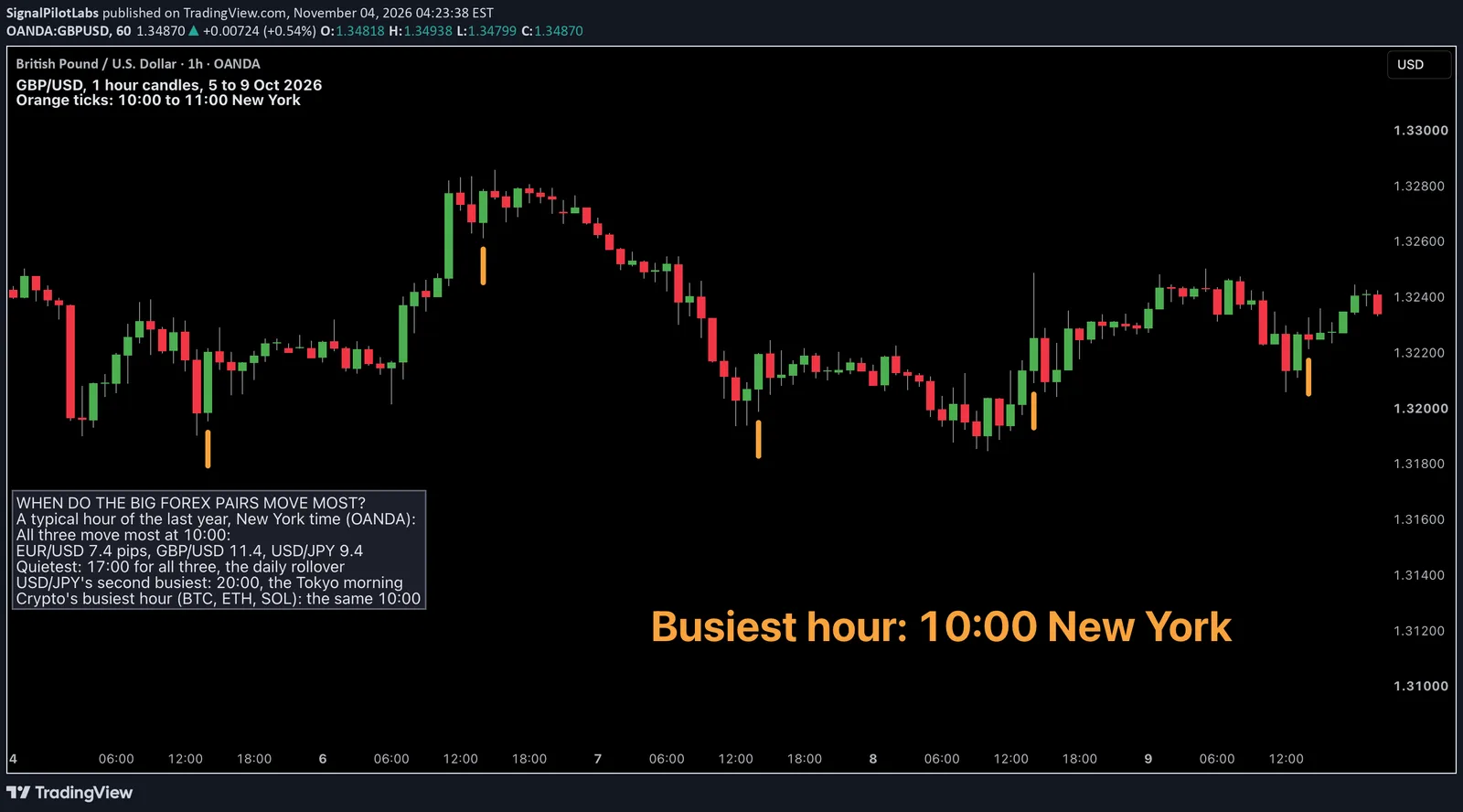
GBP/USD, 1 hour, 5 to 9 October 2026, with an orange tick under each day’s 10:00 New York candle. It’s the pair whose busiest hour stood out most from its typical hour, by the rule we set before running it.
That hour moved more than the day’s typical hour on four of the five days. On Monday it was the biggest hour of the day, 21.9 pips. Friday’s was quiet, 1.7 pips.
Crypto’s busiest hour, measured the same way on Bitcoin, Ether and Solana, was the same 10:00 to 11:00 New York, in our post on the busiest hour of the day, with all 50 coins in its table.
What this does not tell you
Which way the hour goes, or what any one day will do. A median hides the big news days. One year, three pairs, one data feed, past data.
What it’s good for is knowing when your pair usually moves, and when it usually doesn’t.
Observations, not recommendations.
We’re Signal Pilot Labs. We build the Elite Seven, seven indicators for TradingView, and we post what we measure, including the parts that didn’t work.
See what we build at signalpilot.io.
Published as a TradingView Idea on GBPUSD. View the chart on TradingView
Past measurement described after the fact. Nothing here is a recommendation or an indication of future results.